
Pick your kid up from practice and ask them what they worked on.
They'll say "shooting" or "passing" or "nothing."
Now ask them what their coach said to them, specifically.
That second answer is usually a lot shorter. There's a reason — and it's not the coach.
Run the Numbers
Here's a typical competitive practice:
- 90 minutes total
- 16 players
- 1 head coach (sometimes 1 assistant)
Now subtract the parts that aren't coachable one-on-one time:
- 10 minutes of warm-up
- 10 minutes of water breaks and transitions
- 25 minutes of scrimmage at the end
- ~45 minutes of group drills where the coach is talking to the team
If a coach uses every spare second to deliver individual feedback — which no human actually does — that's maybe 5 to 7 minutes spread across 16 players.
Per player: 20 to 30 seconds.
Per practice.
Over a Season
A typical youth season runs about 30 weeks with two practices a week.
Best case, with a coach who actively prioritizes individual feedback:
- ~3 minutes of personalized attention per practice
- ~6 minutes per week
- ~3 hours total across the entire season
That's about half the length of one school day.
For your kid's entire year of competitive soccer.
3 hours a season isn't enough. Add a personal coach.
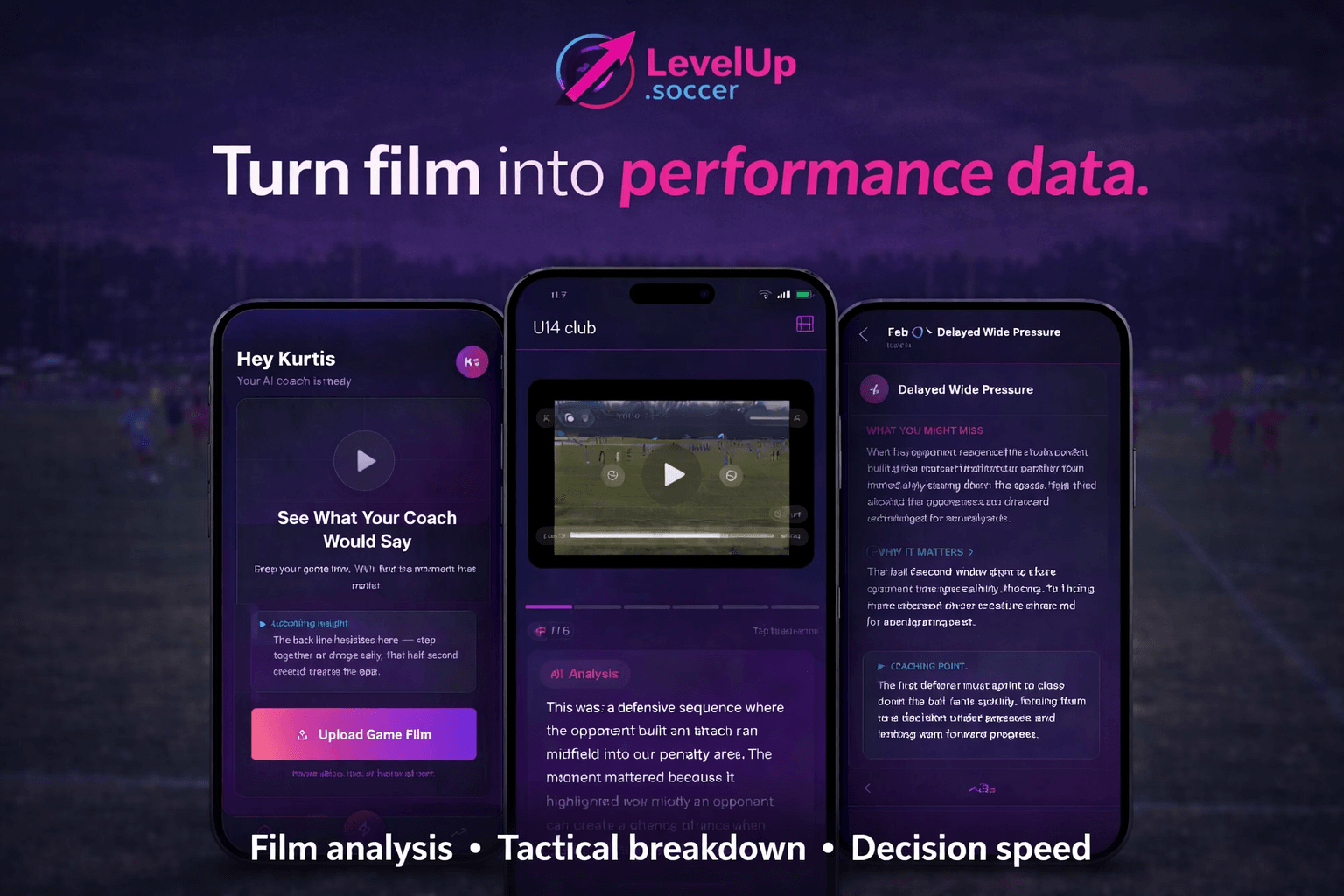
LevelUp gives your player frame-by-frame coaching on their own clips — the kind of one-on-one attention the team setting can't deliver. Two reports a week is more personal coaching than a whole season at the club.
7-day free trial · No card required · Cancel anytime
Why the Coach Isn't to Blame
A coach standing in the middle of 16 players has to make a choice.
They can either:
- Stop the whole drill to fix one player's first touch, while 15 kids stand around
- Or keep the drill moving and address the unit
Stopping the drill is bad for the team. So most good coaches keep it moving.
That's not negligence. That's the only sane choice inside the structure.
What 3 Hours of Coaching Can and Can't Do
Three hours over a season is enough to:
- Encourage
- Spot a few obvious habits
- Correct one or two things in passing
It is not enough to:
- Build a weak foot
- Fix scanning timing
- Diagnose and rebuild a first touch under pressure
- Create a development plan and check progress against it
Those things take real, sustained, personal coaching. The team setting can't deliver it, and pretending otherwise leaves families confused about why their hard-working kid isn't getting better.
What Actually Closes the Gap
Two layers, used together, work the best:
- Daily reps: 15–25 minutes of focused home work on one technical theme
- Weekly personalized review: a coach (human or AI) watches a clip of your player and tells you what to work on next
That second layer is the one most families have never had access to. LevelUp's Film Room was built specifically for it — a private trainer's eyes on every clip, without the private trainer's price tag.
Until recently, that was reserved for academy players and pros.
Why the Math Changes by Age Group
The "3 minutes per practice" number is the average. The lived experience is different at each age, and it's worth knowing what to expect at yours.
U8–U10: Lots of chaos, very little personalization
At this age, practice is mostly about engagement. The coach is spending energy keeping 16 kids on task, not breaking down anyone's technique. Personal attention is closer to 0–2 minutes per kid per practice — and most of that is behavioral, not technical.
This is fine for the age. But if you assume your U9 is "getting coached" in any individual sense, the math says otherwise.
U10–U12: The 3-minute middle
This is roughly where the 3-minute average comes from. Coaches at this age can usually run drills with intent, give some technical corrections, and at least see each player do something on the ball each practice. But the moment they pause to coach one kid for longer than a minute, the other 15 drift.
This is also the age where the families adding an individual layer start pulling away from the families who aren't — because both groups are getting roughly the same 3 minutes at practice, and the difference is what happens outside it.
U12–U14: Less individual time, not more
Parents often assume their kid gets more personal attention as they move up. The opposite is usually true. At U13–U14 the practice has to cover more — tactics, set pieces, shape, role-specific work — and the per-kid time drops, often to 1–2 minutes.
It's also the age where the gap between players who've had individual development and players who haven't becomes hard to close, because the others have been compounding for years.
U14+: Team-first, almost entirely
By U15–U16 the focus shifts heavily to team performance. Personal technical work, if it happens at all, is something the player drives themselves. The coach is preparing a team for tournaments and showcases — that's the job.
At every age the number trends the same direction: the team needs more, the individual gets less. Which means the individual layer has to live somewhere else.
What Coaches Actually Try to Do in Those 3 Minutes
It's worth being honest about what 3 minutes can and can't deliver. Watch any good club coach at a U10–U12 practice and they're cycling through roughly this menu:
- "Open up your hips." Body shape correction. 10 seconds. Move on.
- "Pick your head up." Scanning prompt. 10 seconds. Move on.
- "Use your laces, not your toe." Technical correction on a single touch. 15 seconds. Move on.
- A quick over-the-shoulder during a drill. One or two reps watched, one short cue. 20 seconds.
- A halftime sentence. "Track back on transitions." 10 seconds.
Add up the menu and you're somewhere between 90 seconds and 4 minutes of actual personalized coaching per practice. That's not laziness — that's a smart coach maximizing what's possible.
But notice what's missing from the menu: watching your kid play for two minutes uninterrupted and then telling them the one thing to change. There's no time for that, and there's no clip to watch.
That's the part the team setting can't deliver — and the part your player needs most.
The Two Layers That Compensate
If 3 minutes a practice is what the club delivers, what does it take to make up the difference? Not a second club. Not a private trainer twice a week. Two small layers, sustained.
Layer 1: Daily solo reps (~15–25 minutes a day)
A simple at-home block, four to five days a week, on one technical theme at a time. Weak-foot wall passes for two weeks. Then close control under pressure. Then receiving on the half-turn. One thing at a time, repeated until it's not new anymore.
Most parents instinctively want variety. Players who actually improve get the opposite: narrow focus, long repetition, then move on.
Layer 2: One personalized review a week (~10 minutes)
A 30–60 second clip of your player — solo work or a game touch — watched honestly, with two or three specific things named. Not "great hustle." Things like: "Your first touch is going too far in front of you on the receive; that's why you're getting dispossessed in tight space. Try to kill it under your standing foot this week."
For most of soccer history this layer required a private trainer with a stopwatch. That's what's changed: this layer now exists in a phone, for the price of a youth soccer ball per month.
Together those two layers add up to ~2 hours of personalized development per week — versus the ~6 minutes a player gets at the club. That ratio is why one player separates from the pack and another doesn't, even when they're on the same team.
The team setting is doing its job. The two layers do the player's.
Get the Personal Coaching the Club Can't Give
Upload a clip of your player. Get a frame-by-frame coaching report on their specific decisions, technical habits, and what to work on this week — measured against the standards real coaches use.
7-day free trial · No card required · Cancel anytime · See pricing