
NCAA Division I men’s soccer could be heading toward its biggest calendar shift in decades. A proposed two-semester season would spread competition across fall and spring beginning in 2027–28, moving the Men’s College Cup to spring. The NCAA has backed the change—but it is not final. At LevelUp.soccer, we support the direction because a longer competitive calendar could create a more continuous platform for player development.
October 22 Update: Coaches Reaffirm Support for the Flex Model
In an October 22, 2026 statement, United Soccer Coaches reaffirmed its support for the Division I Men’s Soccer Oversight Committee’s Redistribution/Flex Model. The association says it has supported the concept for more than 15 years, emphasizing a balance of personal, academic and soccer priorities alongside high-quality development.
This is a fresh statement of support for the reform—not a new NCAA approval or confirmation that implementation is final. It reinforces the development case for a better-distributed calendar while the rule remains subject to the NCAA’s rescission process.
What Happened With the NCAA Men’s Soccer Season Change?
On October 7, 2026, the NCAA Division I Cabinet affirmed a proposal to move men’s soccer competition to a two-semester model. That means meaningful regular-season matches would take place in both fall and spring instead of being concentrated almost entirely in the fall.
But there is an important qualification: the Cabinet did not reach the 75% support threshold required to avoid an additional review process. The change has entered a 30-day rescission period. According to the NCAA’s current announcement, at least 241 Division I schools, representing two-thirds of the membership, would have to vote to rescind the measure for it to be defeated.
Bottom line: the new NCAA men’s soccer calendar has advanced, but its implementation is not guaranteed. If it survives the rescission period, it is scheduled to take effect with the 2027–28 academic year.
How Would a Fall-and-Spring College Soccer Season Work?
Here is what the NCAA proposal would mean:
| Calendar element | Proposed Division I men’s soccer format |
|---|---|
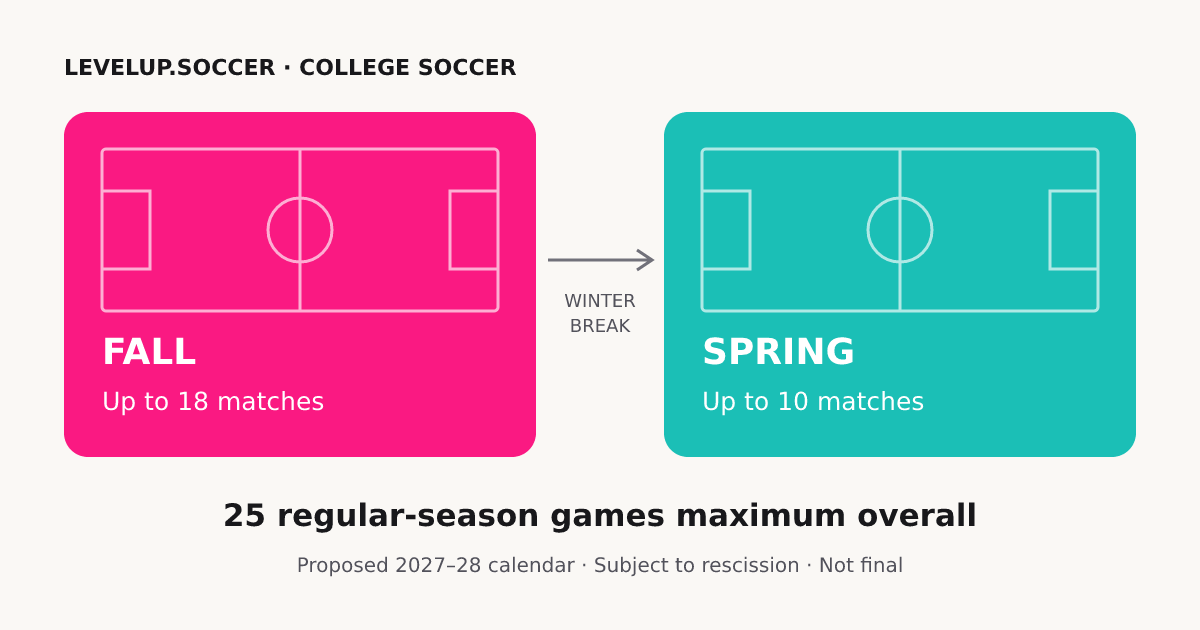
| Fall competition | Begins in late August and ends before Thanksgiving; up to 18 matches |
| Winter interval | A break between the fall and spring competitive segments |
| Spring competition | Begins in mid-February; up to 10 matches |
| Total regular-season games | Still capped at 25 overall |
| Soccer activity allowance | United Soccer Coaches says the model retains the current 132-day/25-game soccer activity limits |
| NCAA tournament / Men’s College Cup | Moves from the traditional December finish to spring; exact dates TBD |
| Earliest effective date | August 1, 2027, if the rule survives rescission |
One detail deserves special attention: 18 fall matches plus 10 spring matches does not authorize a 28-game regular season. The NCAA says the overall limit remains 25. Teams would be able to distribute their allowed competition across two semesters.
That is exactly why the proposal matters. It is not simply about adding games. It is about changing the structure and pacing of meaningful competition.
The “Flex” part also matters. United Soccer Coaches describes a framework that gives conferences and institutions autonomy and flexibility in scheduling and resource allocation. The intent is not one identical weekly timetable for every program; schools still need to account for their academic calendars, facilities, travel and local conditions.
Why Is the Current College Soccer Season So Compressed?
Under the traditional Division I men’s format, most of the competitive season is played in a 10- to 13-week fall window, culminating in the Men’s College Cup in December, according to the NCAA.
That structure creates an intense competitive stretch. Matches, recovery, travel, classroom commitments and preparation all compete for time during a narrow period.
An athlete can play a match, recognize an issue in performance, and have only a short turnaround before the next competitive test. Coaches can still teach and develop players in that environment—but the calendar makes it harder to create longer, consistent cycles of training, feedback and match application during the championship season.
For LevelUp, that is the underlying issue: a strong player-development pathway should not be built around one short burst of competitive matches.
Why LevelUp Supports a Longer College Soccer Season
LevelUp.soccer supports the proposed NCAA two-semester men’s soccer season.
Our reason is straightforward: developing soccer players requires continuity, not just a high volume of games squeezed into a few months.
Improvement happens through an ongoing cycle:
Train with intention → compete under pressure → analyze what happened → adjust → train again → test the improvement in another match.
That cycle works best when there is enough time between meaningful competitions to make changes, while competition continues to provide real feedback over a sustained period.
A fall-and-spring season could create a stronger structure for that process. It gives college programs a chance to connect training, recovery, tactical education, and competition across more of the academic year instead of compressing the championship calendar into the fall.
This does not mean every added month automatically makes players better. Coaches still need thoughtful practice design, appropriate workloads and individualized development plans. But the calendar can either support those efforts or constrain them.
A longer calendar offers a better platform. What programs do with it will determine the developmental result.
How Does NCAA College Soccer Compare With International and Professional Development?
This is one reason the proposed NCAA soccer season change matters beyond college athletics.
In many international club academies and professional leagues, players operate within competitive calendars that extend over many months. Training, matches, performance review and tactical adjustments form a continuous rhythm.
U.S. college soccer is a different environment: athletes are also students, and universities have distinct academic, financial and travel obligations. But the comparison raises a fair development question:
If college soccer is an important pathway toward the professional game, should its main competitive calendar more closely resemble the extended development cycles players may encounter at the next level?
We believe it should move in that direction.
That is also consistent with the broader conversation within American soccer. In October 2025, U.S. Soccer’s NextGen College Soccer Committeerecommended a full-academic-year model for men’s college soccer as part of wider efforts to strengthen player development, student-athlete well-being and connections with professional pathways.
The NCAA’s specific 2027 proposal is not identical to every detail of the NextGen recommendations. Still, both reflect a recognition that the college soccer calendar deserves modernization.
It would be going too far to say that the traditional NCAA schedule alone explains any gap between American soccer and international development systems. Many factors influence player outcomes. But the unusually concentrated competition calendar is a real structural difference—and one worth improving. Our youth soccer development pathway guideexplains how college fits into the broader progression.
Why a Longer Calendar Does Not Mean More Games
Some headlines make the proposal sound like NCAA soccer teams would simply play more matches.
That is not what the published legislation says.
The proposal retains the existing 25-game maximum for the regular season. Instead, it allows teams to spread those games across two competition segments.
United Soccer Coaches’ October 22 statement adds a related clarification: the model would not expand the current 132-day/25-game soccer activity limits. A season spanning more months is therefore not the same as a larger soccer activity allowance. The opportunity is to distribute the permitted work and competition more thoughtfully.
That distinction strengthens the development argument. The goal should not be to fill every week with matches. It should be to create enough room for high-quality training, appropriate recovery, tactical learning and competitive application.
A longer calendar can also reduce the pressure to stack matches closely together, although the actual benefit will depend on how individual schools and conferences schedule their games.
More calendar runway can support more development time—even without more games.
What Could Stop the NCAA Two-Semester Season?
The proposal has meaningful opposition, and some concerns are legitimate.
In June 2026, the NCAA reported that 20 Division I conferencesopposed the proposal and raised questions about the length of the season, championship selection, academic impacts, eligibility for midyear enrollees and other operational issues.
Schools also have practical challenges to solve. Northern programs may face difficult weather during the proposed February competition restart. Facilities and staffing must be coordinated with other spring sports. Athletic departments would need to plan budgets, travel, academic scheduling and game-day operations across two semesters.
These challenges should be addressed—not dismissed.
At the same time, implementation complexity does not erase the underlying case for a more balanced, development-oriented calendar. Thoughtful scheduling and regional competition may help, but the NCAA and its member institutions would need to work through the details.
When Would the NCAA Men’s College Cup Move to Spring?
If the change takes effect, the Division I Men’s Soccer Championship would move to the spring semester. The NCAA said on October 7 that the exact timing remains to be determined with staff and broadcast partners.
So while the proposal would end the traditional December championship structure, there is no confirmed spring College Cup date to put on your calendar yet.
United Soccer Coaches’ October 22 statement describes a move from mid-December to early May. That is the window described by the association, not a confirmed NCAA championship date. The NCAA announcement still leaves the exact spring timing to be determined with staff and broadcast partners.
Does the Proposal Affect NCAA Women’s Soccer?
No. The October 7 NCAA announcement applies to Division I men’s soccer. The Division I Women’s Soccer Oversight Committee considered the concept but did not advance an equivalent proposal.
Women’s college soccer should not be described as changing to this format under the men’s legislation.
The Bigger Opportunity: Make Continuous Player Development the Standard
At LevelUp.soccer, we see the proposed two-semester calendar as more than a scheduling adjustment.
It is an opportunity to rethink how competition supports development.
Soccer improvement is a process—not an event and not a single fall season. Players need repeated opportunities to work on technical skills, understand tactical decisions, improve their game intelligence and apply those improvements against real opposition.
That principle matters in NCAA Division I soccer, but it also matters for younger athletes building toward the next level.
A strong development environment connects everyday work to competitive performance. Extending the competitive calendar gives colleges a greater opportunity to build that connection over time. For a practical example of linking feedback to the next training cycle, see how to use soccer game film to build an IDP. Role-specific practice is covered in our soccer position guides.
Our position is simple: player development should help shape the calendar, not be constrained by it.
We hope the NCAA and its member schools find a workable path to implement this reform, because a longer, better-balanced competitive season could strengthen college soccer’s role in the American player-development pathway.
Frequently Asked Questions About the NCAA Soccer Calendar
Is the NCAA men’s soccer two-semester season officially approved?
The NCAA Division I Cabinet affirmed the proposal on October 7, 2026, but the rule remains subject to a 30-day rescission period. As of October 22, implementation is not guaranteed. United Soccer Coaches’ renewed support is not a separate NCAA approval.
When would the new NCAA soccer season start?
If it takes effect, the two-semester model would begin in the 2027–28 academic year, with an effective date of August 1, 2027.
Will NCAA soccer move entirely to spring?
No. The proposed model divides men’s Division I competition between fall and spring, with the championship moving to spring.
Will college soccer teams play 28 regular-season games?
No. The schedule allows up to 18 fall and 10 spring games, but keeps the combined regular-season maximum at 25.
Would the men’s soccer transfer window move too?
If the calendar change is implemented, the NCAA says the notification-of-transfer window for men’s soccer would occur after the championship concludes in spring. This was included in the NCAA’s October 7 announcement; it is not a new rule announced by United Soccer Coaches on October 22. Exact window dates are not confirmed in that announcement, and this should not be read as a blanket change to every recruiting or eligibility rule.
Why does LevelUp support the longer season?
Because a longer competition calendar creates more opportunity for sustained training, meaningful matches, performance feedback, recovery and adjustment across the academic year. The potential benefit is continuity of player development, not simply more games.
Would this change apply to women’s college soccer?
No. The legislation concerns Division I men’s soccer; the women’s oversight committee did not advance the same proposal.
Develop With Purpose, All Year
The NCAA conversation highlights something we believe at LevelUp.soccer: real player development is continuous. Whether your competitive calendar is short or long, meaningful improvement comes from intentional training, feedback and progress over time.
Start My Pathway to College with LevelUp 360 and connect your development to your college soccer goals.
Sources
- NCAA: DI Cabinet narrowly affirms men’s soccer calendar proposal — October 7, 2026
- United Soccer Coaches: Support for the Redistribution/Flex Model — October 22, 2026
- NCAA: Committee adopts two-semester playing season for DI men’s soccer — May 13, 2026
- NCAA: Cabinet remands two-semester proposal for review — June 24, 2026
- U.S. Soccer: NextGen College Soccer white paper announcement — October 16, 2025
- U.S. Soccer: NextGen College Soccer recommendations